 Anaquant HCP analysis I Protein characterisation I Protein analysis
Introduction
In the biotherapeutics field, regulatory guidelines require pharmaceutical laboratories to document all additional components present into the final product, and to explore potential consequences. In this study, a biotherapeutic recombinant protein was observed, after purification, under mono- and dimer forms. Consequently, a loss of therapeutic activity appeared. Thus, a reducing agent was added to the product, the sodium metabisulfite (SMB), since this latter is the only one authorized to be injected on human patients. This reducing agent is known to involve cysteine sulfonation. However, for this protein, after that SMB was added, UV signal at 280nm was lost and protein became undetectable by LC-UV, which is critical to obtain regulatory agreement and control production batches. The hypothesis was that tryptophan (W) amino-acid were probably impacted and not only cysteine amino acid. A targeted MS-based approach was developed, to discriminate potential sulfonated W from no sulfonated ones, and to assess the reaction reversibility that also could be a key point in protein activity.
Results and discussion
Sulfonation is known to induce 80 Da mass shift. First of all, it was controlled that SMB was responsible of cysteine sulfonation (figure 1). Sample treated with SMB was digested but neither reduction nor alkylation was performed to avoid the destabilization of the potential bond between peptide and SO3 group. Indeed, the modification reversibility was not yet tested, and an unexpected break of the liaison could bias results interpretation. Cysteine-containing peptides under sulfonated or no sulfonated forms were monitored. Results demonstrated (figure 1) that 2 cysteine-containing peptides were detected with cysteine sulfonation. No-sulfonated forms were not detected, which allows to conclude that sulfonation rate is close to 100%.
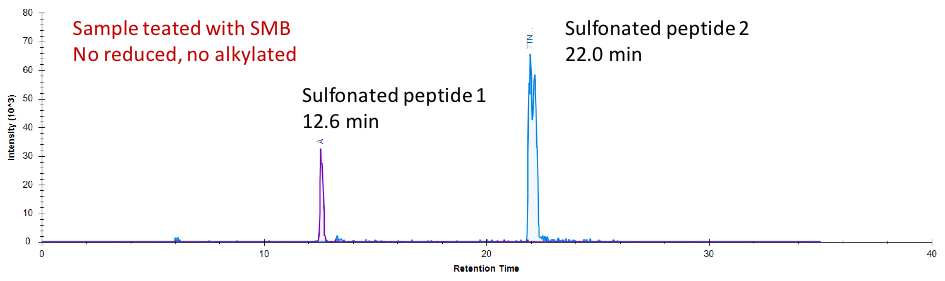
Figure 1: Extracted ion chromatogram obtained by monitoring cysteine-sulfonated peptides in sample treated with SMB. Sample was not reduced and not alkylated.
This experiment allowed to conclude that cysteines are sulfonated with SMB. To explore more in details, it was necessary to explore whether the modification was reversible. So, the sample treated with SMB was digested, but after reduction and alkylation steps. Cysteine-containing peptides were monitored by SRM either under sulfonated or carbamidomethylated forms. Results demonstrated that peptides were detected only under carbamidomethylated form (modification induced after alkylation), which means that modification is reversible (figure 2).
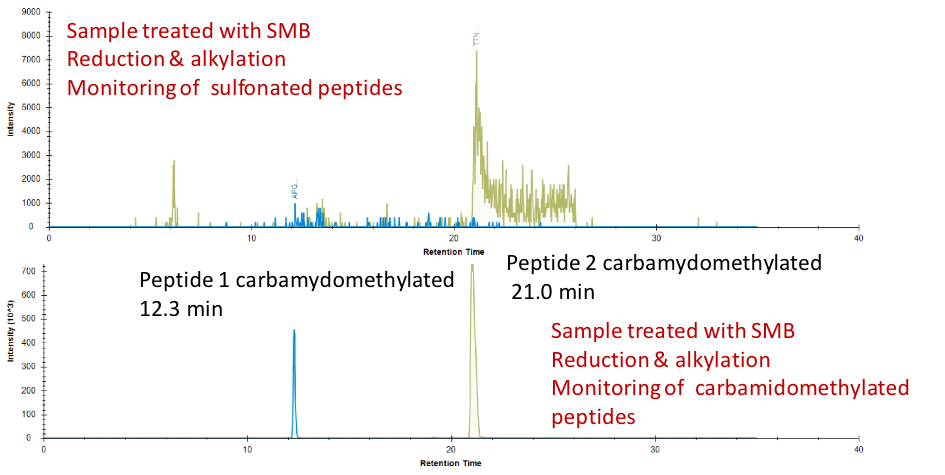
Figure 2: Extracted ion chromatogram obtained by monitoring cysteine-sulfonated and cysteine-carbamidomethylated peptides in sample treated with SMB. Sample was reduced and alkylated.
After that cysteine sulfonation was tested, and detected, the hypothesis of W-sulfonation was tested. Thus, sample treated with SMB was digested with or without reduction and alkylation steps. Then W-containing peptides were monitored either under sulfonated or no sulfonated forms. Without reduction/alkylation steps, results demonstrated that both forms were detected but peptide was mainly detected under modified form (figure 3). With reduction/alkylation steps, results were found similar (figure 4).
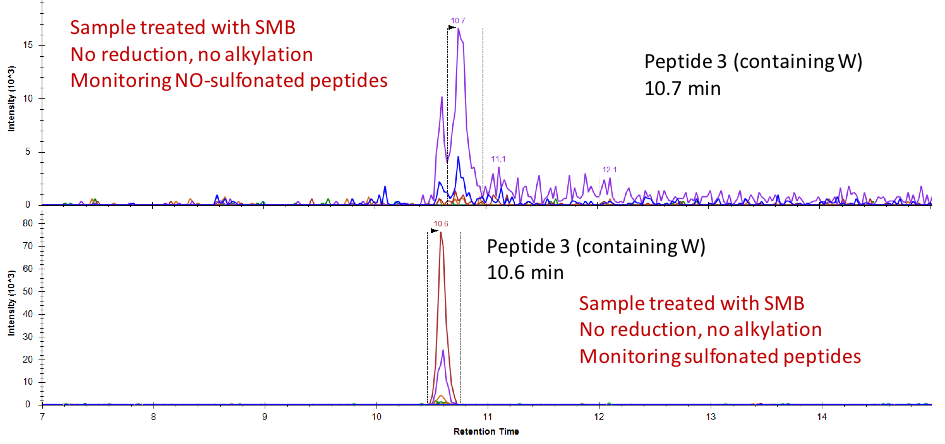
Figure 3: Extracted ion chromatogram obtained by monitoring tryptophan-sulfonated and tryptophan-no sulfonated peptides in sample treated with SMB. Sample was not reduced and not alkylated.
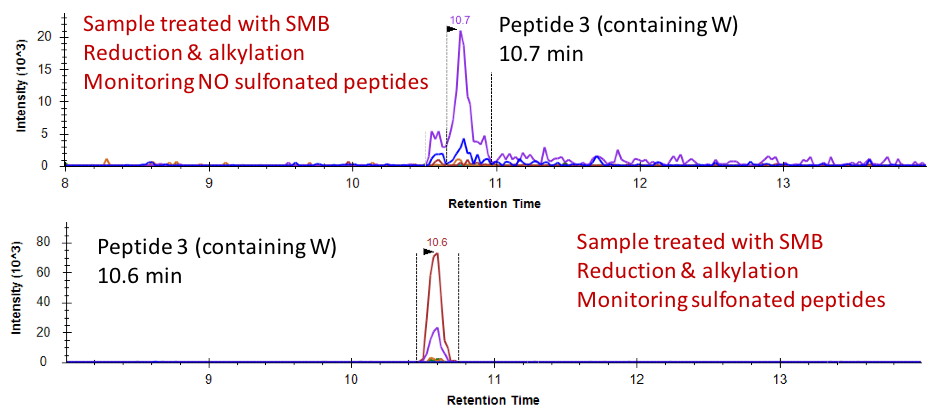
Figure 4: Extracted ion chromatogram obtained by monitoring tryptophan-sulfonated and tryptophan-no sulfonated peptides in sample treated with SMB. Sample was reduced and alkylated.
These results confirmed the W-sulfonation hypothesis, and it appeared that, in contrary to cysteine-sulfonation, the modification is non reversible when occurs on tryptophan amino acids. Also, modification of tryptophan aromatic cycle can explain the absorbance drop at 280nm.
Conclusion
This study proved the power of targeted MS approach to detect and potentially quantify chemical modifications. In this particular work, the results allowed to understand the loss of absorbance at 280nm. Further investigations, using the developed targeted MS-based approach allowed to fix that a concentration of 5 mM of SMB slightly impact the tryptophan, and could be compatible with regulatory requirements.